
Why Do Online Casinos Offer Sports Betting?

Open almost any modern online casino today and, alongside the slot machines and roulette tables, you will likely find a sports betting section — football, basketball, tennis, and often esports. At first glance, this combination might seem odd, since casinos and sports betting have historically been quite separate businesses. Yet this pairing is no coincidence — it reflects both sound business economics and a clear shift in what users actually expect from a platform. This guide breaks down why operators combine both, what it means for you as a user, and how to make the most of this model.
Key Takeaways
- Operators combine casino and sports betting to cut acquisition costs
- One account covers both products — single verification, single payment method
- Casino margins are stable and predictable; sports betting margins fluctuate with the season
- Bonus terms are often structured to push you toward the product you use less
- Hybrid platforms are convenient but make overspending easier — set limits for both sections
- Set responsible gambling tools separately for casino and sports, not just one
Why Casinos and Sports Betting Increasingly Work Under One Roof
Over the past five to seven years, the boundary between online casinos and sports betting has been quietly dissolving. Understanding why helps you make better sense of what you’re actually looking at when you sign up to a new platform.
The One-Stop Principle – User Convenience
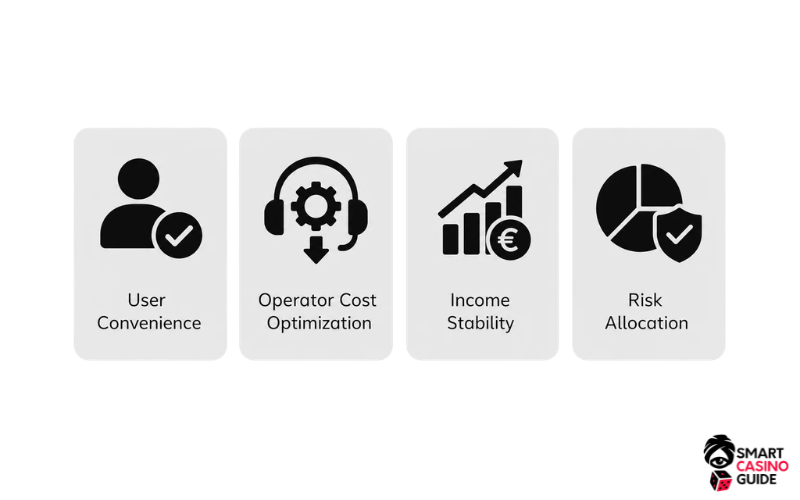
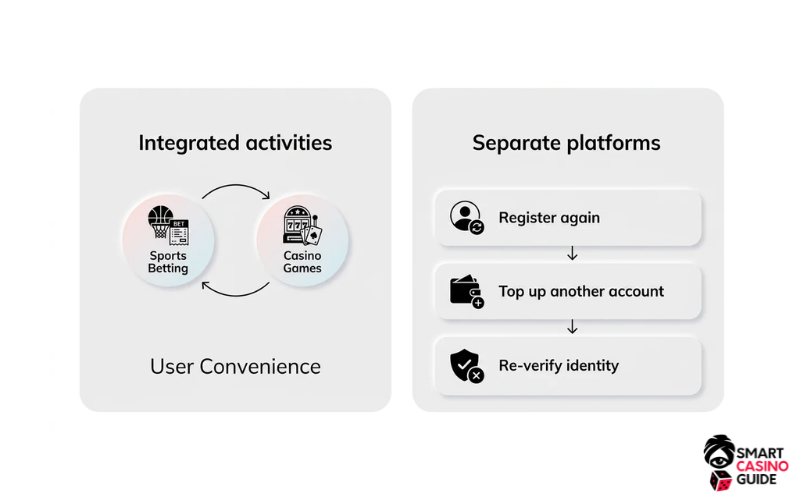
Most people who use online betting platforms don’t stick rigidly to just sports or just casino games. These activities tend to overlap naturally: you might check football odds in the evening, and while waiting for kick-off, spin a few rounds on a slot. If a platform only offers one of these options, you have to open another site — another registration, another deposit, another identity check.
That friction adds up quickly. Operators have noticed this, which is why “everything in one place” has become a standard offering rather than an exception. For you, it simply means fewer accounts to manage and a more seamless experience overall.
Optimization of User Acquisition Costs
The single biggest expense for any gambling operator is not licensing or technical infrastructure — it’s attracting new users. Acquiring one bettor is generally believed to cost somewhere between €200 and €400. Once a user is on the platform, it makes obvious commercial sense to offer as many services as possible.
Integrating sports betting into a online casino — or vice versa — is one of the more cost-efficient ways to increase each user’s value without spending more on acquisition. From a pure business perspective, the logic is difficult to argue with.
Income Stability Throughout the Year
Sports betting is heavily seasonal. When the major football leagues end and the basketball season hasn’t started yet, betting volumes drop noticeably. Casino games, by contrast, tend to be remarkably stable throughout the year — roulette doesn’t care about the calendar.
Big sporting events like World Cups or European Championships bring in new users who, once registered, often explore the casino section as well. The two segments complement each other in a way that smooths out the revenue curve for the operator.
Risk Allocation
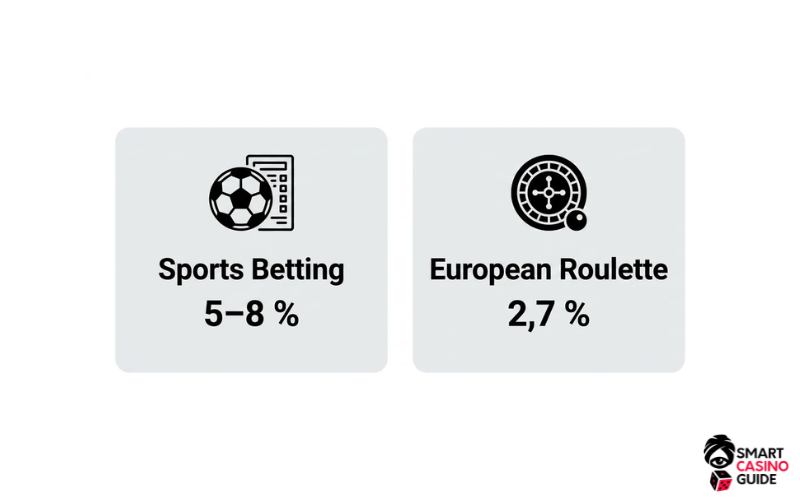
Sports betting typically runs on a margin of around 5–8%. In some cases, particularly when a large number of bettors correctly predict a high-profile outcome, the operator can actually post losses for several weeks. Casino games work differently: the house edge is built in from the start, and slots or table games return roughly 94–97% to users over time, leaving a predictable remainder for the operator.
Combining both products creates a more balanced income stream. A difficult period in sports betting can be offset by steady casino revenue. It’s a straightforward hedge, and it tends to work well.
The Business Logic: How Operators Earn from Both Products
The revenue models behind these two products are meaningfully different, and understanding both can help you make more informed decisions about where your money actually goes.
In sports betting, operators earn from the margin embedded in the odds. A commission built into every bet that averages roughly 5–8% of total turnover. Casino games operate on a fixed house edge: European roulette, for instance, statistically returns 97.3% to users, leaving 2.7% for the operator every round.
According to the American Gaming Association’s State of the States 2024 report, iGaming (online casino) revenue in the United States reached $7.87 billion in 2023 — growing nearly 23% year-over-year and outpacing sports betting revenue growth in every comparable market.
This suggests that casino products tend to be more profitable per active user than sports betting alone, which often functions more as a high-traffic entry point than a primary revenue driver.
When both models work together on one platform, the operator benefits from short-term stability through casino and high-engagement peaks during major sporting events.
Cross-Selling and Why It Matters to You
Cross-selling is arguably the most important mechanic to understand when using a hybrid platform. It directly shapes the bonuses and promotions you’ll encounter.
Consider a common scenario. You deposit €100 and receive a €100 welcome bonus with a 10x wagering requirement. To clear this through sports betting, you’d typically need to place bets with combined turnover of around €2,000 at minimum odds of 1.50. Through casino slots, the same requirement can often be met significantly faster, since most slots contribute 100% toward the rollover.
Operators are well aware of this. The bonus structure is frequently designed — whether deliberately or by default — to guide you toward casino games even if you came for the sports. It’s not inherently a problem, but it’s something worth knowing before you claim anything.
What the Modern User Expects
User expectations have shifted considerably over the past five years, and platforms that haven’t adapted are losing ground to those that have.
More Than One Form of Entertainment
Streaming services, social media, and smartphones have fundamentally changed how people consume entertainment. It’s increasingly common to watch a football match on a phone, check basketball scores simultaneously, and try a few spins in between. Platforms that don’t reflect this multi-activity behaviour tend to lose users to more flexible alternatives.
Live Betting and Live Casino — the Same Principle
The rise of in-play sports betting, which began spreading in the early 2000s, showed clearly that bettors enjoy real-time dynamics. Live casino tables with actual dealers operate on exactly the same principle. It seems reasonable to expect operators will continue investing in both, since broadly the same audience tends to value both experiences.
One Wallet, One Verification
For most users, the practical benefit is straightforward: one account holds your funds, one identity check covers everything, and one set of limits applies to your total activity. This is both more convenient and arguably easier to manage responsibly — your full financial picture sits in one place rather than scattered across several sites.
Sports Betting as a Gateway to Casino, and Vice Versa
Sports betting tends to be more socially accepted than casino gaming. Someone who would never open a dedicated roulette site might register on a betting platform because they follow football. Once inside, the casino section becomes visible and accessible.
The reverse flow also exists. Casino users who discover a sports section sometimes begin following sport more seriously, because placing a bet gives them a reason to feel invested in an outcome. Both directions of this dynamic are well-documented in platform behaviour data, and they underpin much of the hybrid model’s commercial appeal.
Casino Games vs. Sports Betting: Key Differences
These two products serve genuinely different purposes, not just different formats.
The table below outlines the distinctions most worth keeping in mind.
Sports betting offers an intellectual challenge with a slower rhythm; casino games provide fast emotional stimulation. That’s precisely why they tend to work so well together on a single platform.
Advantages and Disadvantages for the Bettor
Using a hybrid platform has real benefits, but it also comes with trade-offs that are easy to overlook.
What to Look for When Choosing a Platform
Not every platform that claims to offer both products actually delivers both well. Knowing what to check before signing up can save you considerable frustration later.
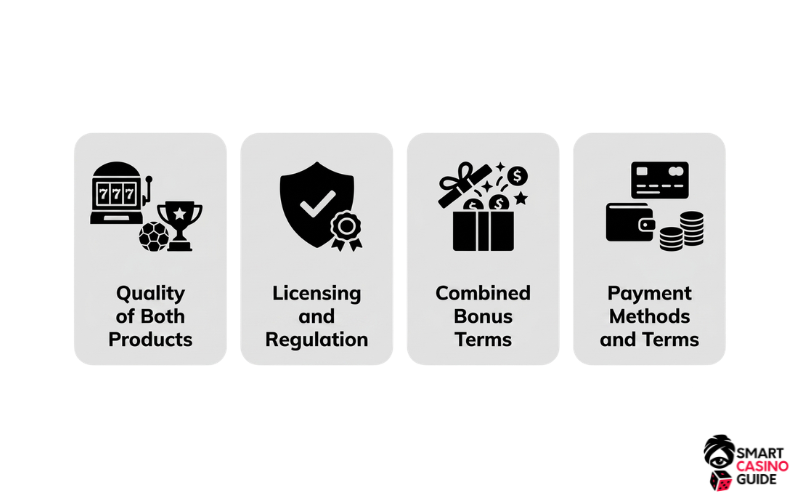
Quality of Both Products, Not Just Quantity
Some operators are strong in sports betting but their casino section amounts to a few hundred titles from a single supplier. Others are the opposite. In our view, a genuinely solid hybrid operator should offer at least 40 sports, 3,000+ casino titles from ten or more providers, and a proper live casino section with a reputable supplier at its core.
Licensing and Regulation
The licence a platform holds matters more than many users realise. Regulators like the Malta Gaming Authority (MGA) and the UK Gambling Commission (UKGC) are generally considered among the more stringent, offering meaningful consumer protections — dispute resolution, responsible gambling requirements, and clear rules around payouts.
Combined Bonus Terms
The most valuable offers are those where wagering requirements can be fulfilled across both sections — sports and casino. If a bonus only counts casino activity, but you primarily bet on sports, that promotion is worth considerably less than it appears at first glance.
Withdrawal Speed and Payment Methods
Hybrid platforms tend to offer a wider range of payment options, sometimes including cryptocurrencies. Check minimum and maximum limits, processing times, and whether any fees apply — these details are often buried in the fine print.
Risks, When “Everything in One Place” Becomes a Problem
The convenience of hybrid platforms has a genuine downside that deserves an honest mention.
When casino games and sports betting share the same screen, switching between them takes one click. Lost on a football bet? The temptation to recover on roulette is immediately available. This is a real behavioural pattern — responsible gambling organisations have documented it repeatedly, and it’s far from hypothetical.
Sports betting has a naturally slower rhythm: you place a bet and wait for the outcome. Casino games are nearly instant. Combining the two can accelerate losses faster than either product would on its own. Data from iGaming Ontario’s 2023 annual report suggested that casino sections generate as much as 80% of operator revenue on hybrid platforms — which implies users tend to lose more through casino games than through sports betting, often without fully realising it.
A few practical steps worth considering:
- Set separate deposit limits for the sports and casino sections
- Use session time reminders available in most platform account settings
- Treat any switch from sports to casino as a deliberate decision rather than a default reaction to a losing bet
- Review your monthly activity across both sections together, not in isolation
Responsible Gambling
In a hybrid model, self-awareness matters more than it does on a single-product platform. Having both activities available at all times increases both exposure and temptation.
Most reputable platforms offer tools that help — deposit limits, session timers, and self-exclusion options. It’s worth setting these up for both sections separately rather than just one. Many regulators also operate national self-exclusion schemes that apply across multiple licensed operators simultaneously.
If you feel that gambling is becoming a problem, support is available through Gamblers Anonymous and GamCare. Gambling should remain entertainment — not a way to recover losses or generate income.
Mainly for business reasons: combining both products reduces user acquisition costs, keeps users on the platform longer, and balances out seasonal revenue drops in sports. It also reflects genuine user demand for convenience.
It can be, provided the platform holds a reputable licence. The main risk isn’t security — it’s that having both products in one place makes it easier to spend more than intended across both simultaneously.
It depends on the platform and the specific offer. Some bonuses allow wagering requirements to be met across both sections; others restrict them to casino games only. Always check the full terms before claiming anything.
They carry a different kind of risk. The main concern is that switching between products requires almost no friction, which can encourage faster and less deliberate spending. Setting separate limits for each section is the most practical safeguard.
Casino revenue is more predictable, since the house edge is fixed. Sports betting margins are smaller and variable — operators can even run at a short-term loss if bettors successfully predict major outcomes. Over time, casino products tend to be considerably more profitable per active user.
Dedicated operators tend to offer more competitive odds and deeper market coverage. Casino-based sports sections are generally more convenient but may offer fewer markets. The right choice depends on how seriously you approach the sports side of things.
Building genuinely competitive products in both areas requires separate teams, technology suppliers, and often separate licences. Some operators simply specialise — they enter the hybrid space to tick a box rather than to compete seriously on both fronts.